


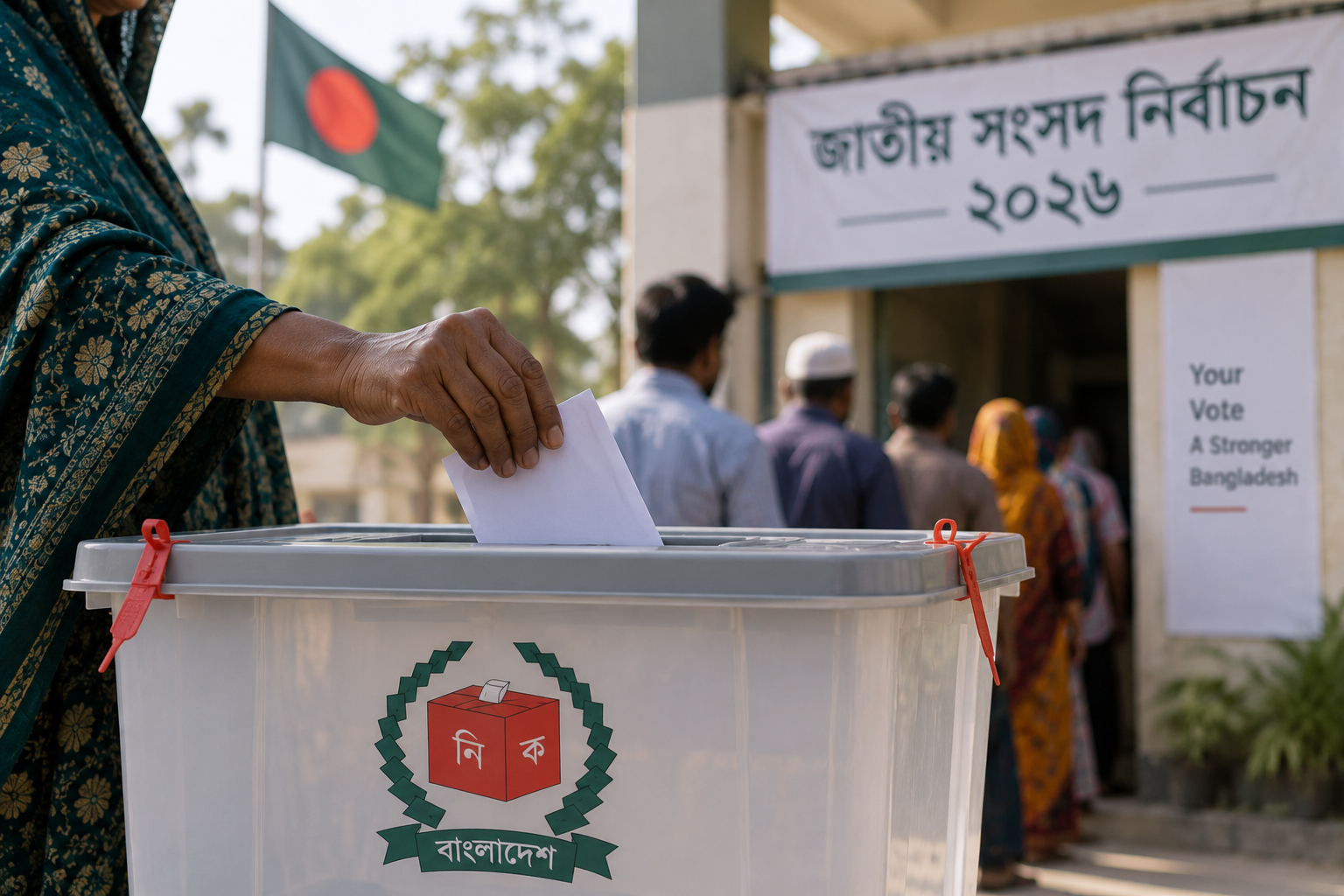
The photo is distributed under the Creative Commons Attribution-ShareAlike 4.0 International (CC BY-SA 4.0) license, originally credited via the Press Information Department of Bangladesh.
Ever since the ouster of former Bangladeshi prime minister Sheikh Hasina, Bangladesh has struggled to regain its democratic roots. With bans on the Awami League, Hasinas old party, Bangladesh goes to the polls to vote for a new government. The current frontrunners are Bangladesh Nationalist Party (BNP) and the Islamist party Jamaat-e-Islami, which has joined with the National Citizen Party (NCP), a party born from the student protests. The elections come after 15 years of authoritarian rule, and is an opportunity for Bangladesh to democratically elect its own government. The European External Action Service has put out its statement on the elections, affirming that they are happy with the conduct of the election. According to the EU, the elections were fair, free and a step towards restoring democratic governance and the rule of law.
While some worries remain about the unconstitutional transfer of power after Hasina left, and the banning of her party in this election, the hope for Bangladesh is that this election can lead to democratic growth in the nation. In 2024, more than 1,400 people died in protests and riots against the administration at the time, led by Sheikh Hasina. The protests were led by students as a response to increasingly authoritarian actions by the former administration.
With the results coming in, the BNP is reported to have won a majority. The BNP has won 209 seats, while Jamaat-e-Islami has secured 68. While Jamaat joined with the student protests, the bigger focus on Islamist issues, failure to select a single woman to represent them and other issues, led some to leave the party. Jamaat-e-Islami has not yet conceded defeat, saying it is unsatisfied with the process. The comments raise fears that the process has not been sufficiently democratic, and that Bangladesh has not yet reached its goals. NCP spokesperson Asif Mahmud has said that its members and representatives have faced threats and violence in the last few days, and without mentioning names, called on the winning party to step in. Jamaat-e-Islami has later retracted these statements, and conceded the elections to BNP. Jamaat has struggled to gain votes when pre-election polling had them neck and neck with BNP, however this did not translate to electoral success. Failing to respond to critics of their position on women, to fears from hindu citizens might have impacted the reception Jamaat got at the ballot box.
The BNP has also signalled it wants to request extradition of former Prime minister Hasina. This would allow the new government to pursue the death-penalty for the disgraced prime minister, who currently resides in India. The topic would no doubt be seen as a point of leverage for the Indian government, who would welcome any ability to influence its neighbour. The extradition of Hasina is by no means a given of course, as India would want to make the best deal it can with the cards dealt.
While we await the last word on the election, the absence of major violence and coercion is a step in the right direction. We hope that Bangladesh can rise above the political instability it has faced in the past, and that the citizens can finally have a fair and free say in their nation. The future of Bangladesh should be in the hands of those that live there, and we hope that other organizations around the world agree. The EU and the UN need to keep observing the current situation, and be willing, and able, to help the people of Bangladesh. If the situation develops, we hope it is in the right direction.